EU E-Bike Regulations 2025: Is the 250W Limit Ending? A B2B Guide
Executive Summary for Importers: While the 250W continuous power limit (EN 15194) remains the legal standard for 2025, industry pressure from Germany (ZIV) is pushing to recognize peak power realities. Simultaneously, new EN 17860 standards are set to redefine weight limits for electric cargo bikes. Here is how to plan your OEM inventory.
⚖️ Current Law vs. Market Reality: The "Gray Zone" Explained
For years, Regulation (EU) 168/2013 has defined the European "Pedelec" (EPAC) with a strict benchmark: 250W maximum continuous rated power.
However, as an experienced OEM manufacturer, POLEEJIEK knows that "Rated Power" ≠ "Peak Power." This has created a tolerated "gray zone":
- The Law: The motor must not continuously exceed 250W without overheating (thermal equilibrium).
- The Reality: Modern mid-drive motors legally labeled as "250W" often output 600W to 800W peak power to conquer steep hills.
⚠️ Critical Note for Buyers: When sourcing frames and motors from China, ensure your supplier understands this distinction. A motor labeled "750W" is currently illegal in the EU as a bicycle. It must be labeled "250W" but engineered to deliver high peak torque.
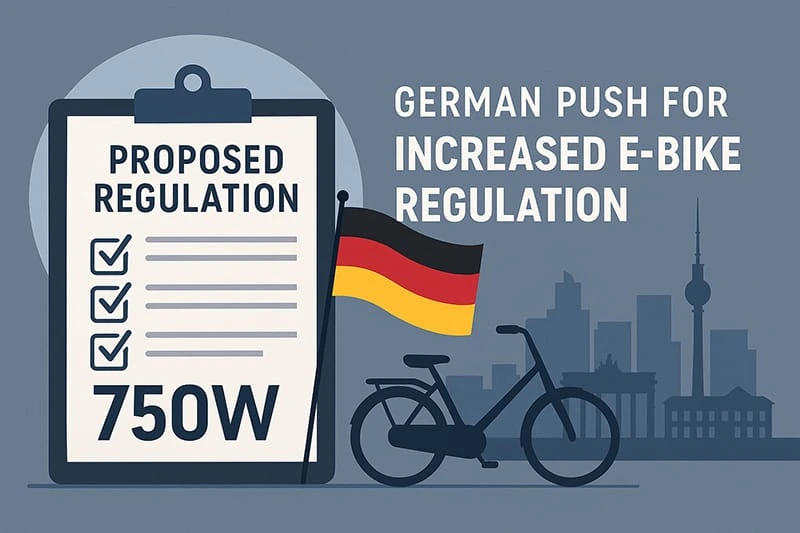
🇩🇪 The "ZIV Proposal": Why Germany Wants 750W
Germany is Europe's largest e-bike market, selling over 2 million units annually. The German Bicycle Industry Association (ZIV) has formally argued that the 250W nominal limit is outdated, especially for the booming Cargo E-bike sector.
Their proposal suggests aligning EU rules closer to North American "Class 1" standards by allowing a clear nominal power increase or explicitly regulating peak power up to 1000W+ for heavy-duty cycles. The rationale is simple: A 250W motor cannot safely haul 200kg of cargo up a 15% incline.
🚚 The New Heavyweights: EN 17860 & Weight Limits
Beyond motors, the most significant regulatory shift in 2025/2026 will be the introduction of the EN 17860 series of standards, specifically targeting cargo bikes.
Unlike standard ISO 4210 tests for city bikes, these new rules propose specific Gross Vehicle Weight (GVW) categories:
| Vehicle Type | Proposed GVW Limit (Bike + Rider + Load) | B2B Impact |
|---|---|---|
| 2-Wheel Cargo Bikes (Long Johns) | Up to 250 kg | Requires reinforced frames and hydraulic brakes (see our BLJ-2016 model). |
| Multi-Wheel Cargo (Trikes) | Up to 300 kg | Likely mandatory parking brakes and wider lane access rules. |
🛠️ Strategic Advice: How to Order for 2025/2026?
Uncertainty can paralyze purchasing decisions. Here is POLEEJIEK's advice for our B2B partners:
- Stick to "250W" Labeling for Now: Until the EU Commission officially amends Regulation 168/2013, importing a bike labeled "500W" or "750W" risks customs seizure or "Speed Pedelec" (L1e-B) classification, requiring insurance and plates.
- Focus on Torque (Nm), Not Watts: Since "Peak Power" is a gray zone, prioritize high-torque motors (80Nm - 120Nm). This offers the "feeling" of a 750W bike while remaining compliant.
- Prepare for "Global SKUs": We can help you design a single frame platform that accepts both a 250W motor (for EU) and a 750W motor (for US), simplifying your supply chain.
At POLEEJIEK, we are already manufacturing to these future-proof standards. Whether you need a folding e-bike compliant for Paris or a high-speed cruiser for California, we adjust the firmware and motor labeling to fit the destination market.
Need a Compliance-Ready Manufacturing Partner?
Don't let regulatory shifts disrupt your supply chain. We build e-bikes that meet current EN 15194 standards and are ready for the future.
Get a Quote TodayFrequently Asked Questions (FAQ)
Is a 750W e-bike legal in Europe in 2025?
Generally, no. As a bicycle (EPAC), the limit remains 250W continuous rated power. A 750W rated bike is classified as an L1e-B Speed Pedelec, requiring a license plate, insurance, and a helmet.
What is the difference between EN 15194 and the new EN 17860?
EN 15194 is the general safety standard for all EPACs. EN 17860 is a new, specific standard being developed for cargo bikes, addressing heavier loads, stability testing, and braking distances for vehicles up to 300kg.
Can I import the same e-bike for the US and EU markets?
Physically, yes, if you use a POLEEJIEK OEM solution. We can use the same frame and battery, but install a 250W motor for EU batches and a 750W motor for US batches, or use software limiting to ensure compliance in each region.